
Author: admin
-
Percentages are everywhere in our daily lives because they help us understand proportions and compare quantities easily. A percentage is a way of expressing a number as a part of 100. For example, when you hear “50% off,” it means you pay half the original price. Here are some common examples of how we use…
-
Angles are measured in degrees from 0 to 360, representing a full rotation around a point. Starting at 0 degrees, the angle increases as you move around a circle. This simple ASCII diagram represents an angle of 60 degrees. The angle is formed between the horizontal line at the bottom and the slanting line above…
-
To solve number sequences (or “strings” of numbers), you need to identify the pattern or rule that connects the numbers. Here’s how you can approach it: Example sequence: 10, 15, 25, 40, ? Step 1: Look at the numbers: 10, 15, 25, 40 Step 2: Are the numbers rising or dropping?10 → 15 (+5), 15…
-
The number of different functions depends on the domain and codomain you consider. If you have a finite domain with ( n ) elements and a codomain with ( m ) elements, the total number of different functions is ( m^n ), because each element in the domain can be mapped to any of the…
-
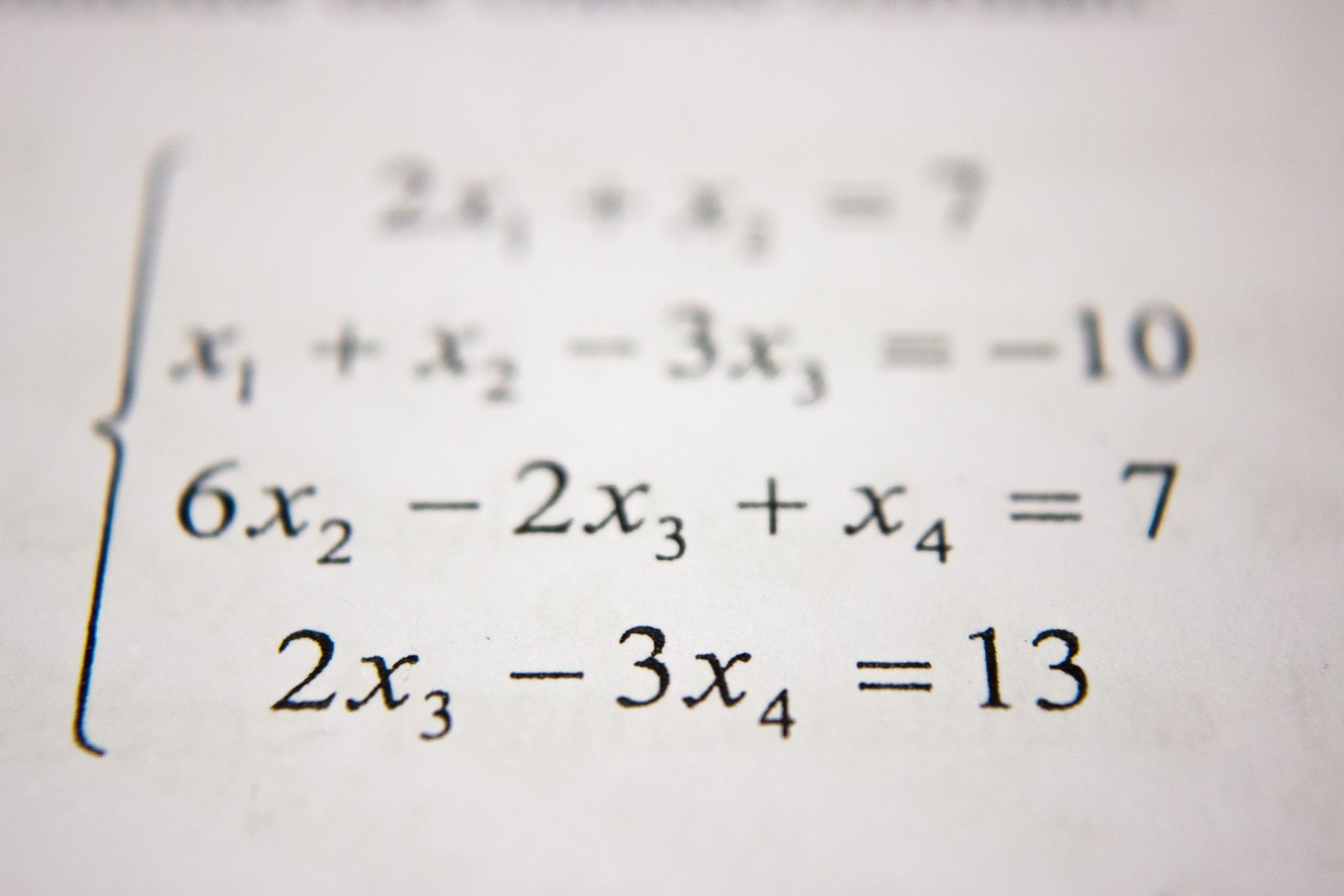
Mathematics is not only a subject in school that gives many people headaches. Nor is it a bunch of numbers, which are there without order or law. Mathematics is a special world in which some completely different laws rules – De Morgan’s laws, Pythagorean theorem, laws of algebra, tautology etc. Walking with me in this…
-

When solving an equation with one variable, the key rule is to isolate the variable on one side of the equal sign and move all the numbers to the other side. To do this, you transfer terms from one side to the other by changing their signs: if a term is added on one side,…
-
Exponents follow specific rules that make working with powers easier, especially when the bases are the same. When the bases are equal, you can add the exponents when multiplying, subtract the exponents when dividing, and multiply the exponents when raising a power to another power. For example, if you have 23 * 24 = 2(3+4)…
-
In many Olympic-level math competitions and tests, students are often not allowed to use calculators. This rule encourages participants to develop strong mental math skills and a deeper understanding of numerical properties. When faced with large numbers or complex expressions, students learn to simplify problems by breaking them down into smaller, more manageable parts. For…
-
Equations with two variables can be solved when we have at least two different equations involving those variables. This is because having two equations allows us to find the values of both variables. There are two common methods to solve such systems: substitution and elimination (also called opposite factors). In the substitution method, we solve…
-
Multiplying numbers by 11, then 111, then 1111, with each other results in palindromic numbers—numbers that read the same forwards and backwards. This fascinating pattern reveals the unique properties of these repetitive multipliers and the symmetry they create in the product. Let’s explore this: 1 × 11 = 1111 × 11 = 121111 × 111…