Angles are measured in degrees from 0 to 360, representing a full rotation around a point. Starting at 0 degrees, the angle increases as you move around a circle.
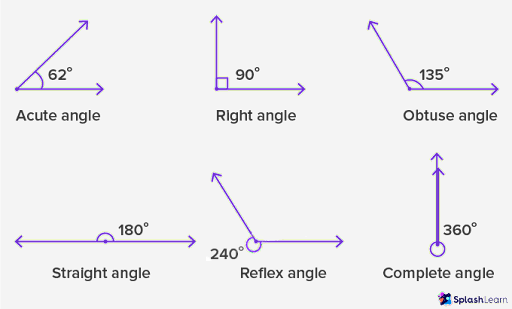
- From 0 to 90 degrees, angles are called acute angles. These angles are sharp and less than a right angle.
- At exactly 90 degrees, the angle is called a right angle. It represents a perfect corner, like the corner of a square.
- Angles greater than 90 degrees but less than 180 degrees are called obtuse angles. These angles are wider than a right angle but less than a straight line.
- At 180 degrees, the angle is called a straight angle, forming a straight line.
- Angles between 180 and 360 degrees are called reflex angles, which are larger than a straight angle but less than a full circle.
- Finally, 360 degrees represents a full rotation, bringing you back to the starting point.
The angle is formed between the horizontal line at the bottom and the slanting line above it.
Look for different types of angles around you (e.g., corners of books, open doors, etc.) to get a sense of acute, right, and obtuse angles.
Transversal and the Relationship Between Angles Formed by a Transversal Across Two Parallel Lines
When a transversal is drawn across two parallel lines, several angles are formed at the points of intersection. These angles have specific relationships that are fundamental in geometry.
Key Angles Formed:
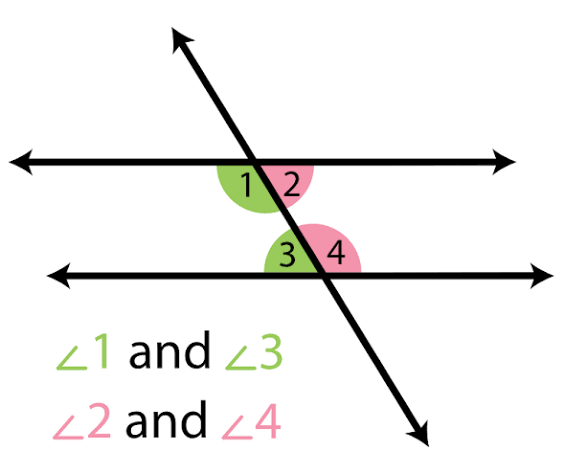
- Corresponding Angles: These are pairs of angles that occupy the same relative position at each intersection where the transversal crosses the parallel lines. For example, the angle at the top left of the first intersection and the angle at the top left of the second intersection.
- Alternate Interior Angles: These angles lie between the two parallel lines but on opposite sides of the transversal. For example, one angle might be on the left side of the transversal at the first intersection, and the other on the right side of the transversal at the second intersection.
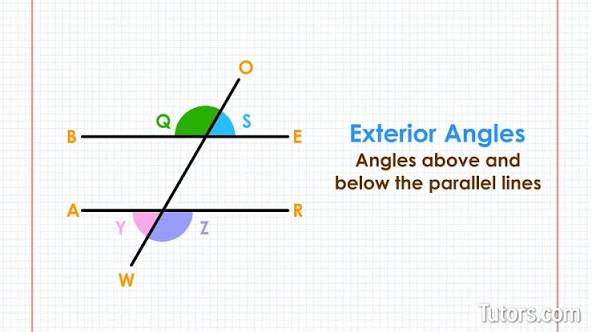
- Alternate Exterior Angles: These angles lie outside the two parallel lines and on opposite sides of the transversal.
- Consecutive Interior Angles (or Co-Interior Angles): These angles are on the same side of the transversal and lie between the two parallel lines.
Relationships Between Angles:
- Corresponding Angles are equal.
- Alternate Interior Angles are equal.
- Alternate Exterior Angles are equal.
- Consecutive Interior Angles are supplementary (their measures add up to 180 degrees).
These relationships help prove that the lines are parallel and are used to solve for unknown angle measures in geometric problems.
How to Measure Angles
Use a Protractor:
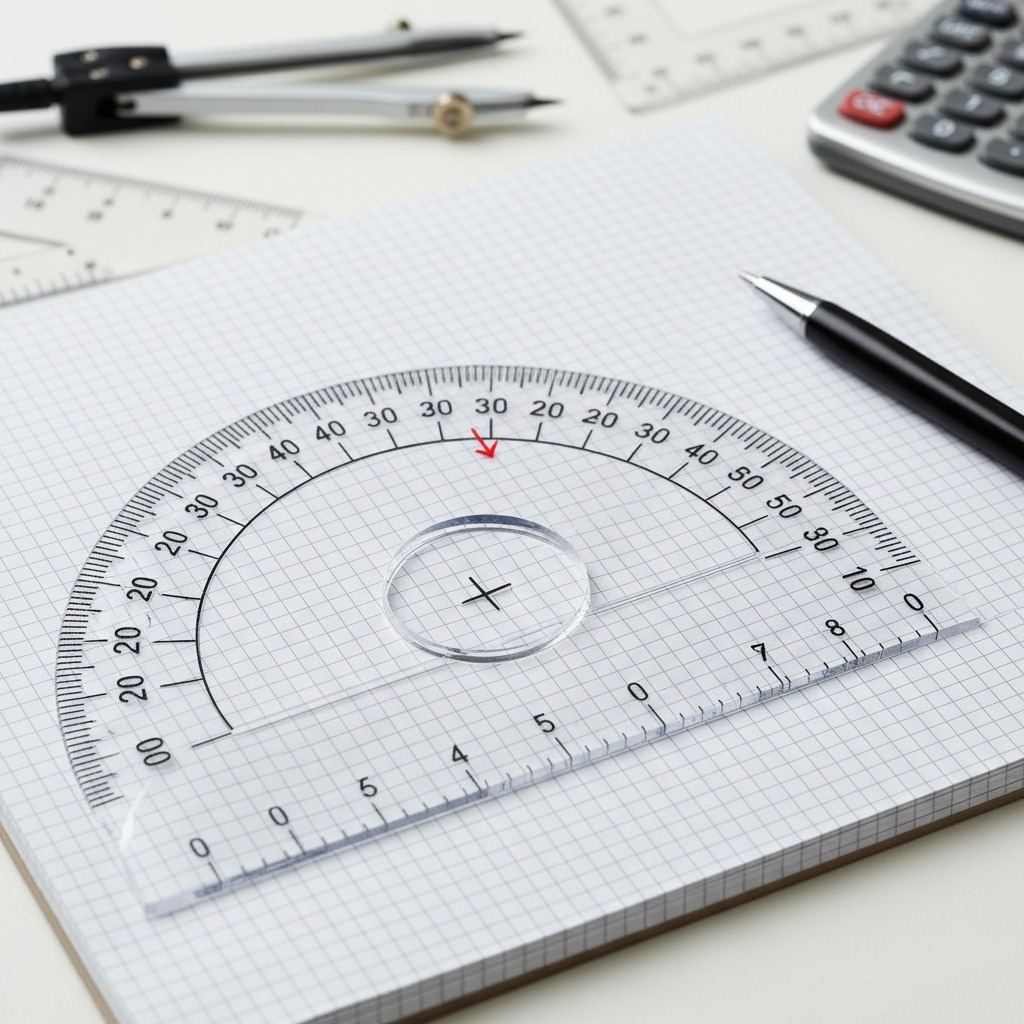
A protractor is a tool used to measure angles. When using it:
1. Align the midpoint of the protractor with the vertex of the angle.
2. Ensure one side of the angle lines up with the zero line on the protractor.
3. Read the degree measurement where the other side intersects the protractor.
Calculating Angles
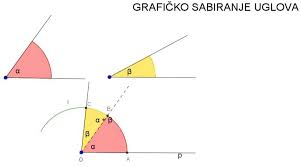
Addition and Subtraction of Angles:
– To find the sum of angles, simply add their measures. For example, if angle A is 30° and angle B is 60°, then angle A + angle B = 90°.
– To find an unknown angle, subtract known angles from a total angle. For example, if the total angle is 180° and one angle is 90°, the unknown angle is 180° – 90° = 90°.
Drawing Angles
- Using a Protractor:
– Place the protractor on the vertex of the angle.
– Mark the angle measure on the paper.
– Remove the protractor and draw the sides of the angle through the marks.
2. Using a Compass and Straightedge:
– To draw a 60-degree angle:
– Draw a base line.
– Open the compass to a specific width and draw an arc across the base line.
– Without changing the compass width, draw arcs from the intersection, creating two intersection points.
– Connect the vertex to the intersection to form the 60-degree angle.
3. Freehand Drawing:
– For rough sketches, practice drawing the different types of angles freehand to improve your skills.
Angles are fundamental elements in every geometric shape.
In a triangle, the sum of the interior angles is always 180 degrees. For example, in an equilateral triangle, each angle measures 60 degrees, while in a right triangle, one angle is exactly 90 degrees. In a square, each interior angle is 90 degrees, adding up to a total of 360 degrees.
Similarly, other polygons have their own angle sums based on the number of sides, calculated using the formula:
(number of sides – 2) × 180 degrees.
Trigonometry primarily deals with the relationships between the angles and sides of right triangles. The main trigonometric ratios—sine, cosine, and tangent—are defined based on the angles of a right triangle.
For a given angle θ (other than the right angle), these ratios are:
- Sine (sin θ) = Opposite side / Hypotenuse
- Cosine (cos θ) = Adjacent side / Hypotenuse
- Tangent (tan θ) = Opposite side / Adjacent side
These ratios allow us to calculate unknown side lengths or angles in right triangles when some measurements are known.
For example, if you know one angle (other than 90 degrees) and one side length, you can use sine, cosine, or tangent to find the other sides.
Trigonometry is essential in many fields such as engineering, physics, and architecture for solving problems involving angles and distances.


Leave a Reply